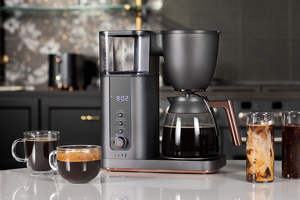
A drip coffee maker looks like the simplest way to brew coffee: add water, add coffee, press the button. But that simplicity is exactly why the result often becomes inconsistent.
One time the coffee tastes watery. Another time it turns bitter. It is easy to blame the machine or the beans. In most cases, the real issue comes down to three things: ratio, grind size, and brew time.
The problem is usually not the coffee maker itself, and not necessarily the coffee. People follow a recipe, but do not understand which variable controls which part of the taste. Ratio, grind size, water, brew time, and clean equipment all work together as one system.
If you change everything at once, the taste becomes hard to control. If you move step by step, you can adjust drip coffee to your taste.
What You Need
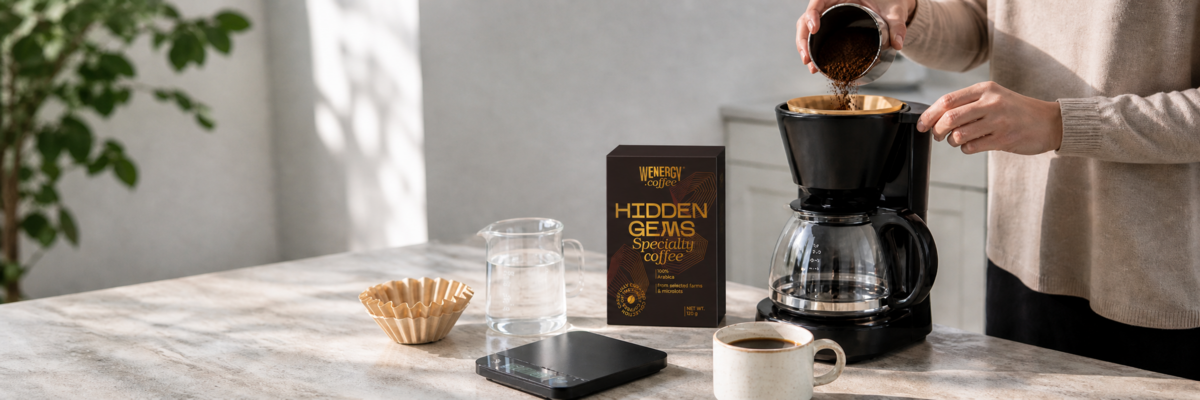
For a basic brew, you will need:
- ground coffee or whole beans;
- a drip coffee maker;
- a paper filter or reusable filter;
- clean cold water.
A kitchen scale is also useful. It is not there to make the process complicated. It is there to make the result repeatable. If your coffee tastes good today, you can brew it the same way tomorrow.
Coffee-to-Water Ratio
A good starting ratio for a drip coffee maker is:
60 g of coffee per 1 liter of water
| Water | Coffee |
|---|---|
| 250 ml | 15 g |
| 500 ml | 30 g |
| 1 l | 60 g |
| 1.5 l | 90 g |
This is not a strict rule. It is a working starting point. If the coffee tastes too light, increase the dose slightly. If it feels too heavy or too dense, reduce the dose.
Ratio is not only about strength. It changes how coffee feels in the mouth: light, full, hollow, or rich.
It is better to start with this ratio. Otherwise, you will change too many things at once and will not know what actually affected the taste.
What Grind Size Works for a Drip Coffee Maker
A medium grind is usually right for a drip coffee maker. But there is an important detail: grind size depends on brew volume.
The more water passes through the coffee bed, the longer the contact time. That means larger batches usually need a slightly coarser grind.
| Water Volume | Grind Size Guide |
|---|---|
| 250–300 ml | closer to a V60 grind |
| 500–750 ml | medium filter grind |
| 1–1.5 l | slightly coarser grind |
| 2 l | closer to a French press grind |
If the coffee tastes sour, thin, hollow, or underdeveloped, the grind is likely too coarse. Water is moving through the coffee too quickly and does not extract enough flavor.
If the coffee tastes bitter, dry, harsh, or leaves an unpleasant aftertaste, the grind may be too fine. Water stays in the coffee bed longer, pulling extra bitterness into the cup.
The weak point of many home recipes is that they give one grind recommendation for every batch size. But 300 ml and 1.5 l are different extraction conditions. The same grind size will not give the same result.
Check Your Water
Coffee is mostly water, so water quality affects taste just as much as grind size or ratio.
Water that is too hard can make coffee taste dull and rough. Water that is too soft or almost distilled can make it taste empty.
At home, the simplest solution is to use good filtered water and avoid boiling the same water many times. If your coffee tastes flat even with the right ratio, start by checking the water.
Prepare the Filter
If you use a paper filter, rinse it with hot water before brewing.
This does two things:
- removes possible paper taste;
- warms the brew basket and carafe.
The smaller the batch, the more noticeable paper taste can be. In two liters of coffee, it may disappear into the brew. In 300–500 ml, it can show up immediately.
If your coffee maker has a reusable nylon filter, you do not need to rinse it with hot water before every brew. But you do need to wash it thoroughly after use. Old coffee oils quickly create unpleasant flavors.
Keep the Coffee Maker Clean
Old coffee oils quickly ruin the taste. They stay on the filter, carafe, lid, spout, and internal parts of the machine.
If the coffee tastes stale, musty, or rancid, the issue may not be the beans. It may be the equipment. This is especially common with drip coffee makers that are not cleaned thoroughly enough.
Step-by-Step Brewing
- Place the filter in the coffee maker.
- If it is a paper filter, rinse it with hot water.
- Discard the rinse water.
- Weigh the right amount of coffee.
- Add the ground coffee to the filter.
- Level the coffee bed gently. Do not tamp it.
- Add clean cold water to the reservoir.
- Start the coffee maker.
- Wait until the brew cycle is finished.
- Gently stir the coffee in the carafe before serving.
Stirring matters. The first part of the brew is often stronger, while the last part is lighter. If you pour straight away, the cup may taste uneven.
How Long Brewing Should Take
Brew time depends on the amount of water and the coffee maker model. These values can be used as a practical guide:
| Water Volume | Approximate Brew Time |
|---|---|
| 250 ml | 2.5–3 min |
| 500 ml | 3.5–4.5 min |
| 1 l | 5–6 min |
| 1.5–2 l | 6–8 min |
If water flows through too quickly, the coffee can taste hollow, sour, or watery. In that case, make the grind finer.
If water flows too slowly, the coffee can taste bitter, dry, or heavy. In that case, make the grind coarser.
How to Know What to Change
The coffee tastes sour, thin, or hollow
Increase extraction: make the grind finer or check whether water is flowing through too quickly.
The coffee tastes bitter, dry, or harsh
Extraction is likely too high: make the grind coarser or reduce the contact time between water and coffee.
The coffee tastes watery
The issue may be concentration, not extraction. Use a little more coffee or a little less water.
The coffee feels too dense or too sharp
Reduce the coffee dose or increase the amount of water without changing the grind size immediately.
Taste in a drip coffee maker works like a pipe: water moves through the coffee bed and pulls soluble compounds from it. If the pipe is too wide, water runs through too quickly and the flavor does not develop. If it is too narrow, water stays too long and pulls extra bitterness into the cup.
Do Not Change Everything at Once
The main mistake when adjusting coffee is changing everything at once: dose, grind size, water, filter, and batch volume. After that, it becomes impossible to understand what actually changed the taste.
Move step by step:
- first, fix the ratio;
- then adjust the grind size;
- check the water;
- evaluate the brew time;
- then check whether the coffee maker is clean.
This way, you do not just get a good cup by chance. You understand how to repeat it next time.
Extraction Formula for a Drip Coffee Maker
For more precise taste adjustment, you can use a TDS meter and calculate extraction.
For a drip coffee maker, the formula is:
E% = (TDS × Brewed Coffee Weight / Dry Grounds Weight) + (0.75 × TDS)
Where:
- E% is the extraction percentage;
- TDS is the percentage of dissolved solids in the brewed coffee;
- Brewed Coffee Weight is the weight of the finished beverage;
- Dry Grounds Weight is the weight of the dry ground coffee.
This is not required for everyday brewing. But if you want to repeat the same taste consistently, the formula helps you understand what is happening: whether the coffee is under-extracted, over-extracted, or within a workable range.
How to Brew WEnergy coffee in a Drip Coffee Maker
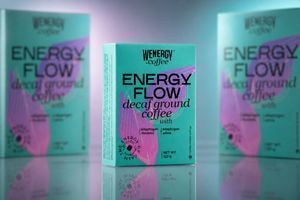
WEnergy coffee works well in a drip coffee maker when you choose the right grind size and keep the ratio under control.
Basic Recipe
- water — 500 ml;
- coffee — 30 g;
- grind size — medium, suitable for a drip coffee maker;
- filter — paper or a clean reusable filter;
- brew time — about 3.5–4.5 min.
Recipe for 1.5 l
- water — 1.5 l;
- coffee — 90 g;
- grind size — slightly coarser than for 500 ml;
- after brewing, stir the coffee in the carafe.
If you use WEnergy coffee ground specifically for a drip coffee maker, the main advantage is that you do not need to find the right grind size yourself. You only need to control the dose, the water, and the cleanliness of the equipment.
The Main Point
A drip coffee maker gives a consistent result not because it does everything for you. It gives a consistent result when you give it the right conditions.
The basic setup is simple: 60 g of coffee per 1 liter of water, the right grind size for the batch volume, a rinsed filter, and a clean coffee maker.
That is enough to make coffee not a one-time success, but a clear brewing method you can repeat.