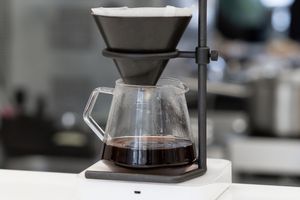
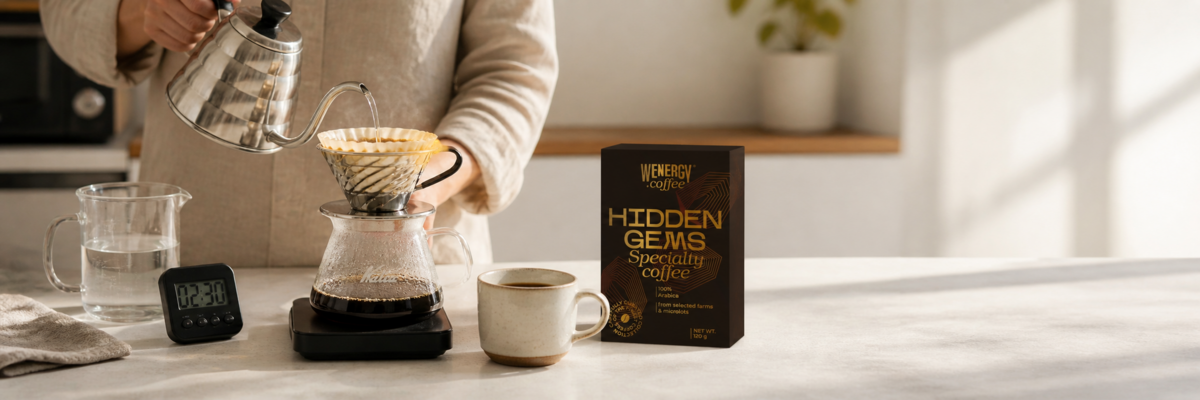
Kalita Wave is a manual dripper for brewing filter coffee. At first glance, it looks like a regular pour-over dripper, but it works differently.
The main difference is Kalita’s flat bottom with three small holes. Water does not flow through one central opening, as it does in a V60. Instead, it moves through the coffee bed more steadily. This makes the flow more even and the result more consistent.
If a V60 depends more on pouring technique, Kalita removes part of that difficulty. It does not do everything for you, but it gives better control over the flow of water.
That is why Kalita is often chosen by people who want manual filter coffee but do not want to fight inconsistent taste every time they brew.
How Kalita Wave Differs from V60
The V60 has a cone shape and one large opening. Water flows through the coffee faster, and the result depends more on grind size, pouring speed, and the precision of your movements.
Kalita follows a different logic:
- flat bottom;
- three small holes;
- wave-shaped paper filter;
- more restricted water flow;
- more even contact between water and coffee.
Because of this, Kalita often produces a fuller, more saturated cup than a V60. At the same time, it keeps the clean taste that people value in filter coffee.
This is not a “pour and forget” method. But it is calmer and less demanding of every movement than many other manual brewing methods.
Which Kalita to Choose: 155 or 185
Kalita Wave comes in two popular sizes: 155 and 185. The right choice depends on how much coffee you usually brew at once.
| Model | Best For | Suggested Recipe |
|---|---|---|
| Kalita Wave 155 | one large cup | 17–18 g coffee to 280–300 ml water |
| Kalita Wave 185 | 2 cups or a larger brew | 29–30 g coffee to 480–500 ml water |
If you usually brew coffee only for yourself, Kalita 155 is enough.
If you often brew for two people or want a larger batch, Kalita 185 is the better choice.
Important: Kalita requires wave-shaped filters in the correct size. Regular flat-bottom filters or basket filters are not suitable.
What You Need
For a basic brew, you will need:
- Kalita Wave 155 or 185;
- Kalita filters in the correct size;
- whole bean coffee or ground coffee;
- hot water;
- a cup or server.
It is useful to have:
- a kitchen scale;
- a timer;
- a coffee grinder;
- a gooseneck kettle.
A scale and timer are not there to make the process complicated. They are there to make the result repeatable. If the coffee tastes good, you should know how to brew it the same way next time.
Basic Coffee-to-Water Ratio
For Kalita, you can start with the classic ratio:
60 g of coffee per 1 liter of water
For home brewing, that looks like this:
| Water | Coffee |
|---|---|
| 250 ml | 15 g |
| 300 ml | 18 g |
| 500 ml | 30 g |
But Kalita has an important detail. Because of its flat bottom and slower drawdown, the cup often feels a little fuller than a V60 brew. That is why these starting recipes are practical:
| Dripper | Coffee | Water |
|---|---|---|
| Kalita 155 | 17–18 g | 280–300 ml |
| Kalita 185 | 29–30 g | 480–500 ml |
These are not strict rules. They are working starting points. If the coffee tastes too light, increase the amount of coffee slightly. If the taste feels too dense or heavy, reduce the dose or add a little more water.
Ratio is not only about strength. It changes how the coffee feels in the mouth: light, full, hollow, or rich.
What Grind Size Works for Kalita
Kalita usually works best with a medium to medium-coarse grind.
Use this as a guide:
- finer than French press;
- coarser than espresso;
- often slightly coarser than V60.
Kalita naturally restricts the water flow a little. If the grind is too fine, the drawdown can take too long, and the coffee may become bitter, dry, and heavy.
If the grind is too coarse, water will pass through too quickly, and the taste may be sour, thin, and underdeveloped.
Start with a medium grind and adjust by taste:
- coffee tastes sour or hollow — make the grind slightly finer;
- coffee tastes bitter or dry — make the grind slightly coarser;
- coffee tastes watery — check the dose as well as the grind.
Water Temperature
A practical temperature range for Kalita is about 92–95°C.
Lighter roasts often need a higher temperature to open up fully. Darker roasts usually need a gentler approach to avoid pulling out too much bitterness.
The simplest way is to bring the water to a boil and let it sit for about a minute. If you have a temperature-controlled kettle, set the temperature directly.
Keep it simple at the start. Use 93°C, fix the ratio, grind size, and time. Then change one variable at a time.
Should You Rinse a Kalita Filter?
Kalita uses thin wave-shaped filters. Their shape matters: the ridges create space between the filter and the dripper walls, helping water move more evenly.
Unlike many other filter methods, Kalita filters are often not aggressively rinsed before brewing. They are thin, and if they become too wet, they can lose their shape. If the filter deforms, water will move through the coffee less evenly.
So the basic rule is simple: place the filter carefully, do not press it against the walls, and do not soak it with a large amount of water before brewing.
If you still notice a paper taste, you can very gently wet the filter with a small amount of hot water without damaging its shape. But for Kalita, this step is not as essential as it is for V60 or Chemex.
Blooming the Coffee
The first stage of brewing is blooming.
The idea is simple: wet all the coffee with a small amount of water and let it sit for 30–45 seconds. This helps saturate the coffee bed more evenly and makes the brew easier to control.
For blooming, use about 2–3 g of water per 1 g of coffee.
| Coffee | Bloom Water |
|---|---|
| 18 g | 36–54 g |
| 30 g | 60–90 g |
For Kalita 155 with an 18 g recipe, use about 45–50 g of water for blooming.
For Kalita 185 with a 30 g recipe, use about 75–90 g of water. After the first pour, wait 30–45 seconds. Once the water has entered the coffee bed, continue with the main brew.
How to Pour Water in Kalita
Kalita is less sensitive to pouring than V60, but that does not mean you can pour randomly.
It is better to pour in a calm, thin stream using small circular movements closer to the center. Do not pour aggressively along the filter walls. The main goal is to wet the coffee bed evenly without disturbing it too much.
Pulse pouring works well with Kalita: water is added in several portions. Because of the flat bottom and three holes, water stays in the dripper a little longer, which supports stable extraction.
There is no need to try to “spin” the coffee the way some complex V60 recipes do. Kalita’s value is that it works more calmly.
Basic Kalita Wave 155 Recipe
This recipe is suitable for one large cup.
Coffee: 18 g
Water: 300 ml
Temperature: 92–95°C
Grind size: medium to medium-coarse
Bloom: 45–50 g of water
Total time: about 3:00–3:30
Brewing steps:
- Place the Kalita filter in the dripper.
- Add 18 g of ground coffee.
- Gently shake the dripper to level the coffee bed.
- Place the dripper with a cup or server on the scale.
- Tare the scale and start the timer.
- Pour 45–50 g of water for the bloom.
- Wait 30–45 seconds.
- Pour up to 150 g.
- At 1:20–1:30, pour up to 225 g.
- At 2:00–2:10, pour up to 300 g.
- Wait for the drawdown to finish.
- Remove the dripper and stir the finished coffee in the server or cup.
Stirring matters. The first part of the brew is usually denser, while the last part is lighter. If you do not stir, the cup may taste uneven.
Basic Kalita Wave 185 Recipe
This recipe is suitable for 2 cups or a larger brew.
Coffee: 30 g
Water: 500 ml
Temperature: 92–95°C
Grind size: medium-coarse
Bloom: 75–90 g of water
Total time: about 3:30–4:15
Brewing steps:
- Place the Kalita 185 filter in the dripper.
- Add 30 g of ground coffee.
- Level the coffee bed with a gentle shake.
- Place the dripper with a server on the scale.
- Tare the scale and start the timer.
- Pour 75–90 g of water for the bloom.
- Wait 30–45 seconds.
- Pour up to 250 g.
- At 1:40–1:50, pour up to 375 g.
- At 2:30–2:40, pour up to 500 g.
- Wait for the drawdown to finish.
- Remove the dripper and stir the coffee in the server.
For Kalita 185, it is important not to grind too fine. A larger dose creates a deeper coffee bed, water takes longer to pass through, and the risk of bitterness increases.
Total Brew Time
| Recipe | Approximate Time |
|---|---|
| 18 g / 300 ml | 3:00–3:30 |
| 30 g / 500 ml | 3:30–4:15 |
Time by itself guarantees nothing. It has to match the taste.
If water passes through too quickly, the coffee often tastes sour, thin, or watery. In that case, make the grind slightly finer.
If the brew takes too long, the coffee may become bitter, dry, and heavy. In that case, make the grind coarser.
How to Know What to Change
The coffee tastes sour, thin, or underdeveloped
Increase extraction. You can make the grind finer, slightly raise the water temperature, or pour a bit more actively.
The coffee tastes bitter, dry, or harsh
Extraction is likely too high. Make the grind coarser, slightly lower the temperature, or pour more gently.
The coffee tastes watery
The issue may be concentration, not extraction. Use a little more coffee or reduce the amount of water.
The coffee feels too dense and sharp
Reduce the coffee dose or add a little more water. Do not change both the dose and grind size at the same time.
The main rule is: do not change everything at once. First, fix the ratio. Then adjust the grind size. After that, work with temperature, time, and pouring technique.
Extraction Formula for Kalita
If you use a TDS meter, you can evaluate the result more precisely through extraction percentage.
For Kalita, V60, and other filter methods, the formula is:
E% = (TDS × Brewed Coffee Weight / Dry Grounds Weight) + (0.75 × TDS)
Where:
- E% is the extraction percentage;
- TDS is the percentage of dissolved solids in the brewed coffee;
- Brewed Coffee Weight is the weight of the finished beverage;
- Dry Grounds Weight is the weight of the dry ground coffee.
This is not required for everyday brewing. But if you are adjusting a recipe and want a repeatable result, the formula helps you understand where the problem is: under-extraction, over-extraction, or concentration.
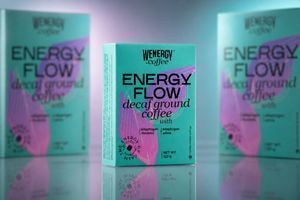
How to Brew WEnergy coffee in Kalita
WEnergy coffee can be brewed in Kalita if you choose a grind size for this method and keep the ratio consistent.
For Kalita 155
- water — 300 ml;
- coffee — 18 g;
- temperature — 92–95°C;
- bloom — 45–50 g of water;
- total time — 3:00–3:30;
- grind size — medium to medium-coarse.
For Kalita 185
- water — 500 ml;
- coffee — 30 g;
- temperature — 92–95°C;
- bloom — 75–90 g of water;
- total time — 3:30–4:15;
- grind size — medium-coarse.
If you use WEnergy coffee ground for Kalita, you do not need to find the right grind size yourself. You only need to control the dose, water, temperature, and pouring technique.
Kalita works well for people who want the clean taste of filter coffee without every small movement having too much influence on the result. It is a manual method with more calm than V60 and more control than a random home recipe.
The Main Point
Kalita Wave is a dripper for people who want manual filter coffee and value consistency.
Its flat bottom with three holes helps control the flow of water. Because of that, the coffee often comes out slightly fuller, smoother, and more consistent than in a classic V60.
The basic setup is simple: Kalita 155 — 18 g of coffee to 300 ml of water. Kalita 185 — 30 g of coffee to 500 ml of water.
A medium to medium-coarse grind, 92–95°C water, blooming, and calm pulse pouring are enough to produce a clean, full, and easy-to-read cup.