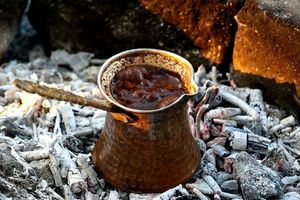
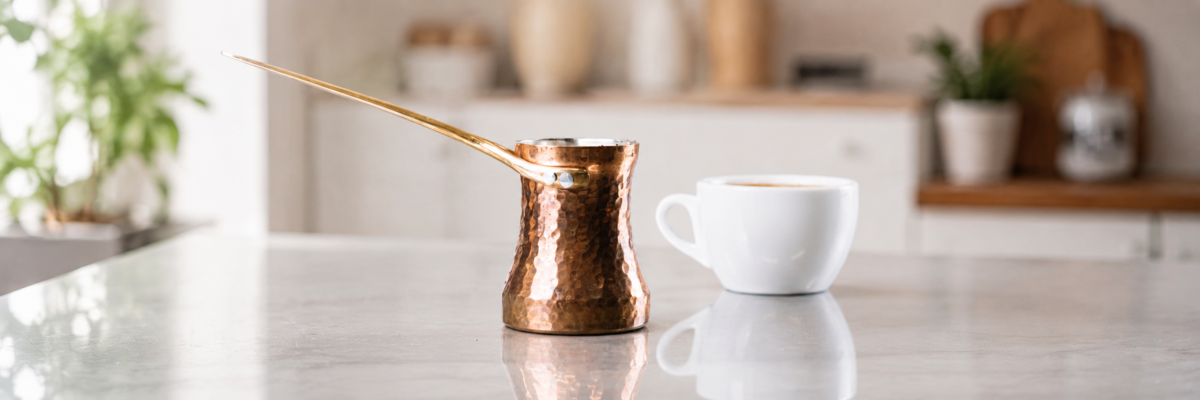
Turkish coffee pot, cezve, and ibrik are different names for one of the oldest ways to brew coffee.
Coffee brewed in a cezve is dense, intense, and highly textured. The reason is simple: there is no filtration. Ground coffee stays in the drink, some fine particles end up in the cup, and the coffee continues to change in taste even after it has been poured.
That is why cezve coffee should not be compared directly with espresso, V60, or French press. It is a separate brewing method with its own logic: an extremely fine grind, slow heating, temperature control, and the right moment to remove it from the heat.
The main mistake is bringing the coffee to an active boil. When that happens, the drink becomes bitter, harsh, and heavy. In a well-made cezve, coffee is not “boiled until it bubbles”. It is heated until a dense coffee foam rises. That is the moment to remove the cezve from the heat.
What You Need
For a basic brew, you will need:
- whole bean coffee or ground coffee;
- a Turkish coffee pot, cezve, or ibrik;
- water;
- a stove or gas burner;
- a spoon.
It is useful to have:
- a kitchen scale;
- a grinder that can grind extremely fine;
- a timer;
- a wide-bottomed cup or a small coffee cup.
A scale is not there to make the process complicated. It gives you repeatability. If the coffee tastes good, you will be able to repeat the recipe instead of starting from scratch every time.
What Grind Size to Use for Cezve Coffee
Cezve requires the finest grind of all common home brewing methods.
Use this guide:
- much finer than espresso;
- not like filter coffee and not like moka pot coffee;
- in texture, closer to powder or very fine flour.
There is an important note here. People often say that you can use a blade grinder for Turkish coffee. Technically, you can, because the grind needs to be very fine. But the result will be unstable: some coffee will be ground almost into dust, while some particles will remain larger.
For a better result, use:
- coffee pre-ground for Turkish coffee;
- a manual or electric grinder capable of grinding extremely fine;
- professional grinding at a coffee shop or store.
If the grind is too coarse, the coffee will taste thin and underdeveloped.
If the grind is too uneven, the cup can taste bitter and hollow at the same time.
How Much Coffee and Water to Use
The basic cezve ratio is:
1 g of coffee to 10 ml of water
In other words:
1:10
| Water | Coffee |
|---|---|
| 70 ml | 7 g |
| 100 ml | 10 g |
| 150 ml | 15 g |
| 200 ml | 20 g |
For a starting recipe, use:
10 g of coffee to 100 ml of water
This is a practical ratio for one full cup. Cezve coffee is best brewed as a single serving. If you pour one cezve into two cups, the grounds and body of the drink will be distributed unevenly.
How to Measure the Working Volume of a Cezve
Do not rely only on the stated volume of the cezve.
What matters is how much water you should use for brewing. Usually, water is not added to the very top, but to a level below the neck where the pot begins to narrow.
If a cezve is labeled as 200 ml, its practical brewing volume may be closer to 150 ml.
A simple way to check:
- Pour water into the empty cezve up to the point where the neck starts to narrow.
- Pour that water into a measuring cup.
- Identify the working volume.
- Calculate the coffee amount using the 1:10 ratio.
For example, if your cezve comfortably holds 150 ml of water for brewing, use 15 g of coffee.
What Water to Use
For cezve coffee, use clean water without chlorine smell or off-flavors.
Filtered or bottled water with moderate mineral content works well.
Water that is too hard can make the taste rougher and heavier. Water that is too soft can make the coffee taste flat and less expressive.
For home brewing, a simple rule is enough: the water should taste good on its own. If the water is unpleasant to drink, it is difficult to make good coffee with it.
Cold or Warm Water
There are two working approaches.
The first is to use cold or room-temperature water. This makes the brew take longer, and the coffee stays in contact with water during heating for a longer time.
The second is to use water at around 60–70°C. This shortens the brewing time and reduces the risk of leaving the coffee on the stove for too long.
For a consistent home recipe, it is better to start with water at:
60–70°C
If you do not have a thermometer, you can mix hot water with a small amount of cold water, or simply let boiled water cool down noticeably before pouring it into the cezve.
What Heat Level to Use
The guide is not “low” or “high” heat by itself, but the total brewing time.
A good working range for cezve coffee is:
2–4 minutes
If the coffee rises after just one minute, the heat is too high. The taste may be harsh and underdeveloped.
If the cezve sits for 6–7 minutes and takes too long to rise, the heat is too low. The drink may become heavy and overextracted.
For a starting point, use medium or medium-low heat and watch how the coffee behaves.
Basic Cezve Coffee Recipe
Coffee: 10 g
Water: 100 ml
Grind size: extremely fine, for cezve
Water temperature: 60–70°C or room temperature
Brewing time: 2–4 minutes
When to remove: when the coffee foam rises close to the edge, but before the coffee boils
Step-by-Step Brewing
- Weigh 10 g of coffee.
- Grind it extremely fine or use coffee pre-ground for Turkish coffee.
- Add the coffee to the cezve.
- Add 100 ml of water.
- Stir well so there are no dry clumps.
- Place the cezve on the stove.
- Use medium or medium-low heat.
- After stirring once, do not stir the coffee again.
- Watch the surface closely.
- When the foam starts rising and approaches the edge, remove the cezve from the heat.
- Pour the coffee into a cup immediately.
- Let the drink sit for 1–2 minutes so the grounds settle and the temperature becomes more comfortable.
Coffee in a cezve should not be brought to an active boil. Boiling breaks control over the process and often brings bitterness.
What the Coffee Foam Is and Why It Matters
As the coffee heats, a dense foam forms on the surface from bubbles, fine particles, and gases.
It matters for two reasons.
First, it is a temperature indicator. When the foam begins to rise, the coffee is approaching boiling point. That is the moment to remove the cezve from the heat.
Second, the foam shapes the first impression of texture. It gives part of the density and velvety mouthfeel people value in cezve coffee.
But the foam should not “explode” over the edge. If the coffee boils over, the process is already out of control.
Should You Raise the Coffee Several Times?
Older home recipes often suggest letting the coffee rise to the edge several times, removing it from heat, returning it to the stove, and letting it rise again.
For quality coffee, this is not necessary.
Multiple rises increase the time coffee spends at high temperature. The drink can become heavier, more bitter, and drier.
For a cleaner result, it is better to make one controlled rise and pour the coffee into the cup at the right moment.
Should the Coffee Rest in the Cup?
Yes, it should.
Cezve coffee is not filtered, so after pouring, the particles need time to settle at the bottom.
Wait 1–2 minutes before the first sip.
During this time:
- the grounds settle;
- the temperature drops;
- the taste becomes clearer;
- the texture becomes softer.
Do not stir the coffee in the cup after the grounds have settled. And do not drink the last sip with the grounds unless you want a harsh, dry texture.
What Kind of Cezve to Use
A good cezve has two important qualities:
- the material conducts heat well;
- the shape helps control the rise of the foam.
Copper cezves conduct heat well and respond quickly to changes in heat. This is useful because it gives you more control over the process.
Ceramic cezves heat up and cool down more slowly. They retain heat longer. If you use a ceramic cezve, remove it from the heat slightly earlier, because the coffee will continue heating for a while after removal.
A neck that is too wide holds the foam less effectively. A neck that is too narrow can create an overly thick foam layer, under which some of the coffee may brew unevenly. A moderate narrowing is usually a better choice.
How to Know What to Change
The coffee tastes bitter, harsh, or dry
Possible causes: brewing for too long, active boiling, grind too fine or uneven, heat too high.
What to do: remove the cezve earlier, do not let the coffee boil, keep the brew time within 2–4 minutes, use water at 60–70°C, and check the grind quality.
The coffee tastes sour or underdeveloped
Possible causes: brewing too briefly, heat too low, too little coffee, or grind too coarse.
What to do: increase the brewing time slightly, grind finer, check the 1:10 ratio, and do not remove the cezve too early.
The coffee tastes watery
Possible causes: too little coffee, too much water, grind too coarse, or brewing time too short.
What to do: return to the 1:10 ratio, grind finer, do not split a large cezve between several cups, and let the coffee reach a proper foam rise.
There are too many grounds in the cup
There will always be grounds in cezve coffee. But if there are too many, the reason may be a very uneven grind or stirring the coffee before drinking.
What to do: let the coffee sit for 1–2 minutes, do not stir it in the cup, do not drink the last sip, and use a more even grind.
The coffee boiled over
The reason is simple: you removed it too late, or the heat was too high.
What to do: next time, reduce the heat, watch the foam rise more carefully, remove the cezve before active boiling, and if using a ceramic cezve, remove it even earlier.
How to Brew WEnergy coffee in a Cezve
WEnergy coffee can be brewed in a cezve if you choose a grind specifically for this method.
Basic setup:
- coffee — 10 g;
- water — 100 ml;
- ratio — 1:10;
- grind size — extremely fine, for cezve;
- water — 60–70°C or room temperature;
- time — 2–4 minutes;
- remove from heat — when the foam rises, but before the coffee boils.
If you use WEnergy coffee ground for cezve, you do not need to achieve an extremely fine grind yourself. This matters because grind size often determines whether cezve coffee will taste dense and clean or harsh and heavy.
Cezve is a good choice for people who want not a clear filter-style cup, but a dense, intense drink with a pronounced texture. It is a slower home brewing method where the main point is not to boil the coffee, but to stop the process at the right moment.
The Main Point
Cezve coffee is brewed without filtration, so it comes out dense, intense, and textured.
The basic setup: 10 g of coffee. 100 ml of water. Ratio — 1:10. Grind size — extremely fine, for cezve. Brewing time — 2–4 minutes. Remove from heat — when the coffee foam rises, but before the coffee boils.
Do not tamp the coffee. Do not bring it to an active boil. Do not stir the drink in the cup after the grounds have settled.
The strength of the cezve is density, intensity, and its characteristic texture. Its weak point is bitterness from overheating. So the key parameters are simple: an extremely fine grind, a 1:10 ratio, time control, careful attention to the foam, and removing the coffee before boiling.