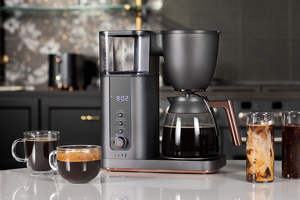
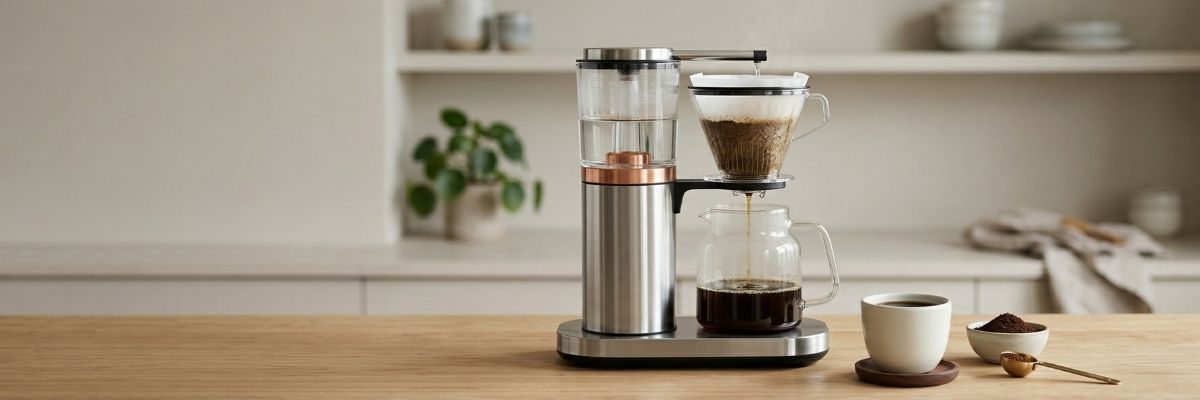
A drip coffee maker is one of the most straightforward ways to brew decaf every day. You do not need to dial in a complicated recipe every time the way you would with manual methods. But there is one common mistake: people assume that if the machine does the work, the flavor will take care of itself. It will not.
With a drip coffee maker, the result depends on a few basic things: the right amount of coffee, the right grind size, decent water, and clean equipment. When those basics are in place, ground decaf coffee gives you a stable and predictable result without extra effort.
What You Need
Required:
- ground decaf coffee;
- a drip coffee maker;
- paper filters, if your machine uses them;
- cold water.
Recommended:
- a scale;
- a clean water container;
- a clear starting ratio instead of measuring by eye.
What Ratio to Start With
A solid working ratio for a drip coffee maker is 60 grams of coffee per 1 liter of water.
That means:
- 250 ml of water — 15 g of coffee;
- 500 ml of water — 30 g of coffee;
- 750 ml of water — 45 g of coffee;
- 1 liter of water — 60 g of coffee.
That is the right place to start. Do not measure coffee by eye. In a drip coffee maker, even a small dosing error shows up clearly in the cup: it will either taste thin or overloaded.
What Grind Size You Need
For a drip coffee maker, the grind should be medium, but not exactly the same for every brew volume.
The logic is simple:
- for 250–300 ml of water, the grind should be closer to a pour-over grind;
- for 500–1000 ml, it should be slightly coarser, closer to a French press grind.
The larger the volume of water, the coarser the grind should be. Otherwise, the water will run through too slowly and the cup will become over-extracted.
What Water to Use
Coffee is almost entirely water, so the idea that “any tap water will do” does not hold up here. If the water is too hard, the cup will taste flat and muted. If it is too soft, the coffee may come out sharp and unbalanced.
The easiest home solution is decent bottled water with no aggressive mineral profile. If you do not like the taste of the water on its own, the coffee you brew with it is unlikely to taste right either.
Why You Should Rinse the Paper Filter
Before brewing, it is worth rinsing the paper filter with a small amount of hot water. This is not cosmetic. It helps get rid of any papery taste.
The smaller the brew size, the more important this becomes. In a large batch that note may disappear, but in 250–500 ml it is often noticeable right away.
If your machine uses a reusable nylon filter instead of paper, you do not need to rinse it this way. But you do need to wash it well after every brew.
Step by Step: How to Brew Ground Decaf Coffee
1. Prepare the Filter
Place the paper filter into the brew basket and rinse it with a small amount of hot water.
2. Add the Coffee
Measure the amount of ground decaf coffee using the basic ratio of 60 g per 1 liter of water. Add it to the filter and level it out evenly.
3. Fill the Reservoir
Use cold water in the volume you need.
4. Start the Machine
From there, the machine does the work: hot water passes through the ground coffee and filter into the carafe or thermal server.
5. Taste and Assess
After brewing, do not rush to change everything at once. First figure out what exactly is off in the cup: weakness, dryness, heaviness, or too much emptiness.
How Long Brewing Should Take
A practical range is:
- about 2.5 minutes for 250 ml;
- up to around 6 minutes for larger volumes, even up to 2 liters.
What matters is not the time from pressing the button, but the time from when the first drops hit the coffee.
How to Tell If the Grind Is Wrong
If the water runs through too quickly, the coffee often tastes thin, weak, and watery. In that case, the grind should be finer.
If the water runs through too slowly, the coffee may taste heavy, dry, and over-extracted. In that case, the grind should be coarser.
The logic is simple:
- too fast — grind finer;
- too slow — grind coarser.
What Else Affects Flavor Besides the Recipe
Even the right ratio will not save the cup if everything else is off. In a drip coffee maker, the result also depends on:
- coffee freshness;
- water quality;
- whether the grind matches the brew volume;
- how clean the machine and filter area are;
- dosing accuracy.
The most common real-world problem is not “bad decaf.” It is stale coffee, a dirty coffee maker, or just guessing the dose.
How to Adjust Flavor Without Overcomplicating It
If the Coffee Tastes Thin and Empty
- make the grind finer;
- check whether you used too little coffee;
- make sure the water is not running through too fast.
If the Coffee Tastes Heavy and Dry
- make the grind coarser;
- check whether you overdid the dose;
- see if the brew is taking too long.
If the Flavor Tastes Flat and Muted
- check the water;
- check the freshness of the coffee;
- make sure the equipment is clean.
Which Decaf Format Works for a Drip Coffee Maker
For a drip coffee maker, the most direct option is ground decaf coffee for filter brewing. If the format is already matched to this brewing method, you do not need to solve the grind question separately.
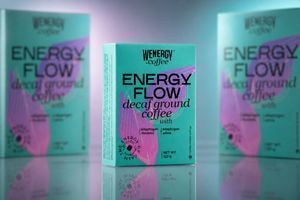
For that use case, WEnergy coffee offers ENERGY FLOW Decaf Filter Coffee 120 g — ground caffeine-free coffee for drip coffee makers.
Frequently Asked Questions
Can I measure the coffee by eye?
You can, but the result will be random. For a stable cup, it is better to use a scale and the basic ratio of 60 g per 1 liter.
Do I need to rinse the paper filter?
Yes, if you want to avoid a papery note in the cup. This matters especially with smaller brew volumes.
What grind size do I need for a drip coffee maker?
Medium, but adjusted for volume. For smaller batches, closer to pour-over. For larger ones, a bit coarser.
What matters more: the recipe or the water?
Both matter. But poor water can ruin even a correct recipe, and a bad ratio can ruin even good water.